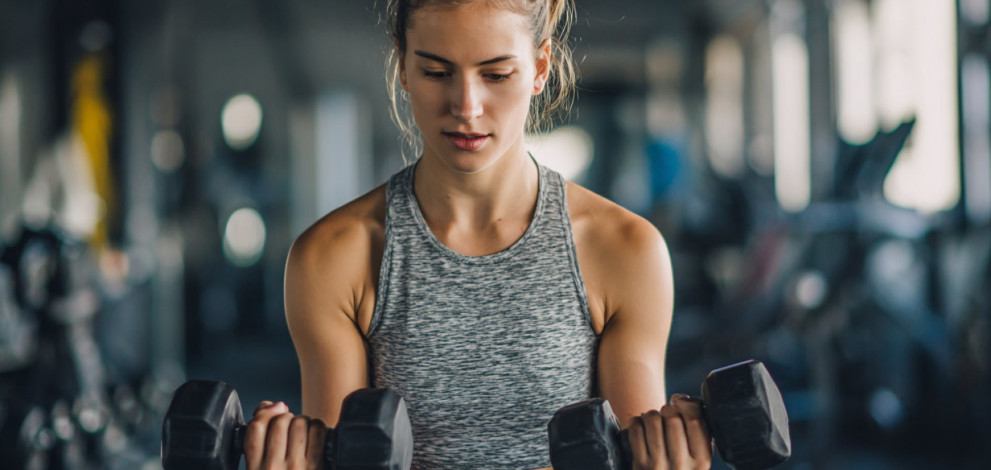
From cycle syncing to supersets: here’s how women should approach resistance training a little differently
Fifteen years ago, exercise guidelines had a shake-up. Instead of just doing exercise, like running or cycling, we should be adding regular bouts of strength training, also called resistance training, to our workouts.
Despite the advice, women have been slower than men to take up strength training, with 24 per cent doing so twice a week, compared with 29 per cent of men, according to a UK study from 2022.
Yet, older women, the demographic least likely to be doing strength training, have the most reason to do it, as the activity not only maintains muscle but also bone strength. And women are most likely to develop the brittle bone disease, osteoporosis, as they age.
As women tend to be smaller and less muscular than men to begin with, they might assume they need to go about strength training differently.
In fact, the principles are broadly similar – but there are a few ways they should tailor their approach, says Dr Emily Hansell, a sports science academic at Loughborough University.
Progress over time
There are a wide variety of exercises that build strength, including ones that use our own body weight, like press-ups and squats, through to ones that require free weights or machines.
Because of their lower strength, women will probably need to begin at lower intensities. But just as for men, the key goal is “progressive overload”, which means gradually raising intensity – either by more repetitions of each exercise or by increasing the weight used. “You’re gradually increasing the volume of load that you’re lifting over time,” says Dr Hansell.
“There is this notion that women shouldn’t lift heavy, but we need to be lifting heavy, while safely, and we need to get there through progressive overload. It is the single most important determinant of someone’s strength gains.”
Cycle syncing
Another common idea is that women should ease off on strength training at certain times of their menstrual cycle, usually claimed to be either the two weeks before their period, or during their period.
The rationale for such so-called “cycle syncing” is that during those weeks, levels of the female sex hormone, oestrogen are lower, which reduces performance.
But this claim is not based on good evidence. Studies have given mixed results, but a 2023 review found that when only higher-quality research was analysed, nine out of ten studies found no difference in strength performance between menstrual cycle phases.
This fits with Dr Hansell’s experiences working with elite athletes. “If we look at when medals have been won and personal records have been set, that’s occurred at every single phase of the menstrual cycle,” she says.
There are potential downsides to advising women to cycle sync. It makes starting and sticking to an exercise programme seem complicated and could put people off, says Dr Hansell.
It could also make it harder to raise intensity over time. “If you’re chopping and changing your program throughout a month, you’re not achieving progressive overload,” she says.
Of course, if someone has period pain, they might find their usual training routine harder, but people should just be guided by their bodies, says Niki Woods, a personal trainer.
Woods disagrees with common advice to routinely swap weights for yoga at the low-oestrogen periods of the menstrual cycle. “The negative impact of that is just too great,” she says. “It’s better to carry on and potentially adapt that day, if you feel like you need it.”
Women best at ‘supersets’
While men are generally stronger than women, there is some evidence that women’s muscles are less “fatigable”. In other words, women can sustain a certain level of force for longer, if it is proportional to their strength.
Woods finds that women may need less time to recover between sets of exercises, and can cope better with “supersets”, moving straight from one set of repetitions to another. “I generally programme more supersets for women than for men,” she says.
But the most important thing is to get on with doing any kind of strength training at all, says Dr Anna Lowe, a researcher at Sheffield Hallam University.
“If you’re untrained, you really don’t need to do much to get massive benefits from engaging in strength training,” she says.
Home workouts can be especially helpful for people short on time, such as those juggling a job with caring responsibilities, she says. “The key thing that stops women engaging in strength training regularly is time poverty.”
Another issue can be weakened pelvic floor muscles after childbirth, which may cause leakage of urine during exertions where people hold their breath. She teaches those affected to exhale as they exert themselves, to reduce the problem.
Exercises that strengthen core muscles, like the plank, can help reduce urine leakage, she says.
Aiming for easy routines that are done regularly chimes with updated US exercise guidelines that came out in March, which said complex routines are unnecessary, and resistance training at home rather than the gym is fine.
Lowe says: “It can be 15 or 20 minutes at home with resistance bands or a couple of dumbbells, and you can make enormous gains in your strength, flexibility and mobility.”