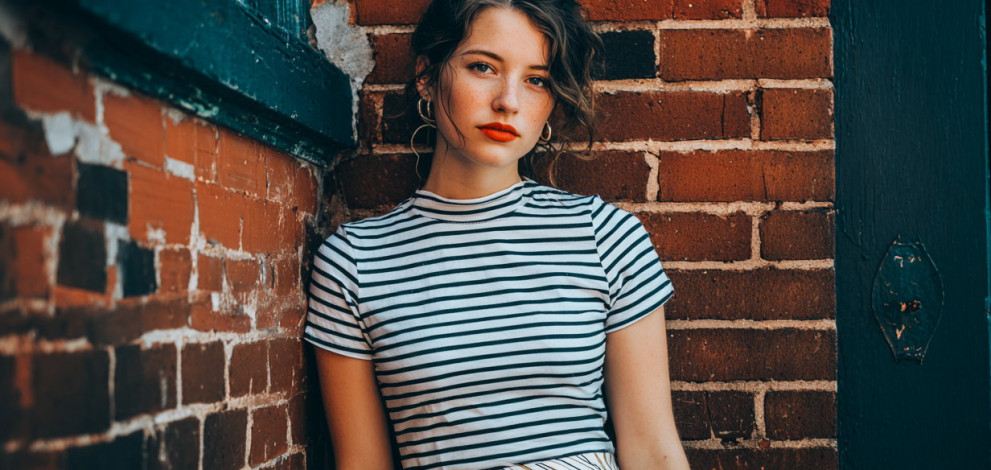
In the hands of today’s designers, the stripe becomes less a pattern and more a point of view, one that brings a sense of playfulness, wit, and expressive ease to the modern wardrobe
Fashion has a long, complicated relationship with the stripe. What began as an ancient weaving technique became, by the Middle Ages, a mark of the outcast: lepers, heretics, and clowns were assigned striped garments as a badge of exclusion. From prison uniforms in penal colonies to the blue-and-white marinière of the French navy, stripes carried the weight of hierarchy and hard labor for centuries. It took the radical eye of Coco Chanel, who in 1917 introduced the Breton stripe shirt as a casual separate, to flip the narrative entirely, turning a sailor’s working garment into the language of leisure and liberation.
That tension between conformity and rebellion, structure and freedom is exactly what makes the stripe so endlessly compelling. In recent collections, designers are pulling at that duality with fresh intent. The maximalist energy building since the industry’s pivot away from quiet luxury has made graphic patterns feel not just acceptable, but necessary.
How designers are reworking the stripe
Recent Spring collections proved that the motif has stripped away its predictable coastal nostalgia for something much more cerebral. At Proenza Schouler, Breton-inspired designs arrived with thinner lines and unconventional colour pairings like camel-and-navy or burgundy-and-ivory. Christopher John Rogers offered a fresh, refined take on the pattern, while labels like Khaite kept the energy taut and modern, and Erdem went romantic without losing precision.
Womenswear and menswear have both leaned heavily into wide, contrasting bands moving in every direction horizontal, vertical, and diagonal. This was especially evident at Stefan Cooke, Off-White, and Sunnei, the latter of whom sat guests over a matching carpet of wide stripes. Most notably, the rugby shirt emerged as a major silhouette, its bold horizontal banding recontextualised through precision tailoring.
Stripes on stripes: the new maximalism
If there is a single styling move that defines this moment, it is the collision of multiples. Chanel and Louis Vuitton both promoted mixing stripes of varying widths and directions the “stripes on stripes” approach as a full celebration of individuality. Layering a wide-stripe coat over a narrow-stripe shirt is no longer considered a pattern clash; it is the point. The underlying logic is architectural: when proportions are considered, the result is visual rhythm rather than noise.
The best striped dressing operates on a “classic with a twist” philosophy. It is eclectic and out-of-the-box, favouring chunkier lines and abstracted graphics. Colour-ways have pushed well beyond oceanic blues and crisp ivory into unexpected territory, like burnt sienna paired with chalk, or cobalt meeting rust.
At the heart of this resurgence is fashion’s renewed fascination with clothes that communicate attitude as much as aesthetics. In a season overflowing with saturated colour, decadent textures, and unapologetic maximalism, stripes offer a striking sense of structure and refinement. They cut through visual excess with graphic clarity, grounding flamboyant styling while still feeling bold and directional. Whether rendered in crisp banker pinstripes, sun-faded resort bands, or fluid painterly lines, the motif carries an inherent sophistication that designers are using to redefine modern elegance. Stripes are no longer simply classic – they are expressive, architectural, and emotionally charged, capable of shifting from sharp tailoring to effortless sensuality in a single look. Their versatility lies in this duality: disciplined yet playful, nostalgic yet contemporary, timeless yet undeniably fashion-forward.